

UX Design GPT: six years of client work in a chat box
A custom GPT trained on more than six years of my design practice. 758 sales, 4.8 stars from 17 reviews, and a price of whatever you feel like.
- 758
- sales
- 4.8
- rating from 17 reviews
Context
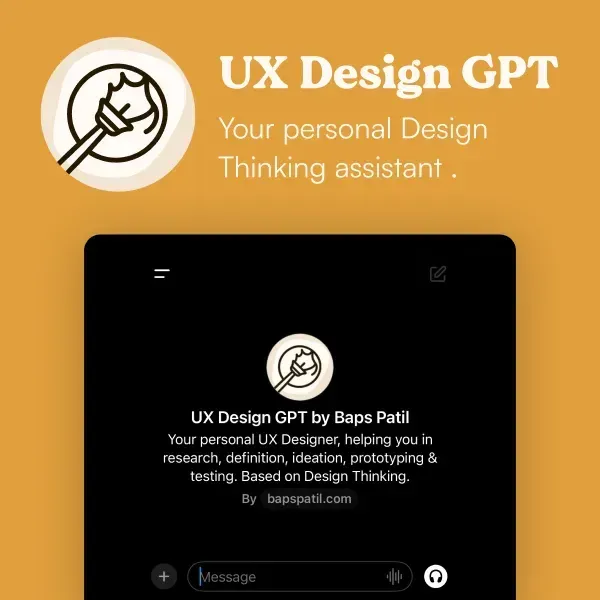
UX Design GPT is a custom GPT built on the knowledge I accumulated across more than six years of client design work. You describe a design problem, it works through it the way I would: framing, research, user flows, information architecture, interface decisions, and the questions you should have asked the stakeholder first.
It went up on Gumroad in November 2023, days after OpenAI let anyone build one. It is free, or pay what you want.
The problem
I mentor a lot of designers, and the same three questions arrive every week. How do I frame this problem. What research do I run when nobody will give me users. How do I justify this to someone who wants it to look like the competitor.
The answers are not secret and they are not short. Writing them out individually is a good use of an hour and a bad use of a hundred hours, and the people who need them most cannot afford a mentoring session.
The generic assistants of the time were confidently mediocre at this. Ask a general model about UX and you get a summary of the top-ranking article on design thinking: the five-diamond, double-square, whatever shape was in fashion, with none of the judgement about when the process is theatre.
My role
Everything. No client, no collaborator, no brief. I wrote the knowledge, designed the behaviour, wrote the store listing, and answered the support email.
Approach
The design constraint of a custom GPT is that you are shaping behaviour with almost no control surface. There is an instruction block, some knowledge files and a toggle for tools. That is it. No fine-tuning, no retrieval you control, no evaluation harness, no way to see what went wrong for a user. So the work is entirely in what you choose to encode and what you choose to refuse.
The first decision was that it asks before it answers. A designer describing a problem in two sentences has left out the constraints that determine everything, and a model that immediately produces a wireframe is solving a problem nobody has. The default is to ask what the constraint is, who the user is, and what has been tried.
The second was that it says when a method is overkill. Most UX advice online is written for a research team at a large company, then applied by a lone designer at a startup with a two-week deadline, where it collapses. Knowing which parts of the process to skip is what six years teaches you, and no article says it out loud.
Building it
It runs on GPT-4 with DALL-E enabled, distributed through Gumroad as a link to the GPT.
The instruction block does the heavy work, structured as a decision procedure rather than a personality description. Most custom GPTs of that era opened with a paragraph about being a world-class expert, which changes nothing, because the model already knows what a UX designer sounds like. What changes the output is telling it what to do first, what to do only under specified conditions, and what never to do.
The knowledge went in as separate documents by domain: research methods with the conditions under which each is worth running, information architecture patterns, interface heuristics with the cases where they conflict, and worked examples from real projects with identifying details removed. Separate files rather than one, because retrieval over a single large document tends to return the same opening section regardless of the question.
DALL-E is enabled for a narrow purpose: rough layouts and mood direction when someone is stuck describing a structure in words. It is not there to produce a design. It is there to give a person something to react to, which is a much lower bar.
Evaluation was manual and unglamorous. I kept about forty real questions from mentees, ran every instruction revision against them, and read the answers looking for two failures: recommending a heavyweight research method to someone with no time or budget, and producing a solution before establishing the constraint. Those two account for most of the ways this kind of assistant is unhelpful while sounding useful.
The failure mode I could not fix is built into the format. I cannot see what users ask, cannot log a bad answer, and have no way to know when the underlying model changes beneath me. A custom GPT is a product built on rented ground, and the landlord does not send notices.
Outcome
758 sales at pay-what-you-want, and a 4.8 rating from 17 reviews. For a free artefact made in a few evenings and distributed with no marketing beyond a link, that is a better return than most things I have charged money for.
The more useful outcome is that the mentoring questions changed. People arrive having already run the framing conversation, so the hour we spend together starts further along.
What I’d do differently
I structured the knowledge files by domain, which is how I think about design and not how people ask questions. Organising them by situation would have retrieved better.
I should also have shipped a page explaining what it is bad at. It is weak on visual craft, weak on current tooling, and it will happily discuss a design system it cannot see. Saying so up front costs nothing and prevents the disappointed messages I did get.